


Cancer commissioning
What is commissioning?
Commissioning is the process of assessing needs, planning, prioritising, purchasing and monitoring health services to achieve the best possible outcomes for patients. In North Central London, through good commissioning we can meet our objectives to plan for the future, to meet national, regional and local priorities. We can also make a measurable difference for patients and the NHS by meeting high standards and ambitious targets.
Commissioners work to ensure equitable access to services and equitable opportunity of outcomes for all.
Commissioning functions
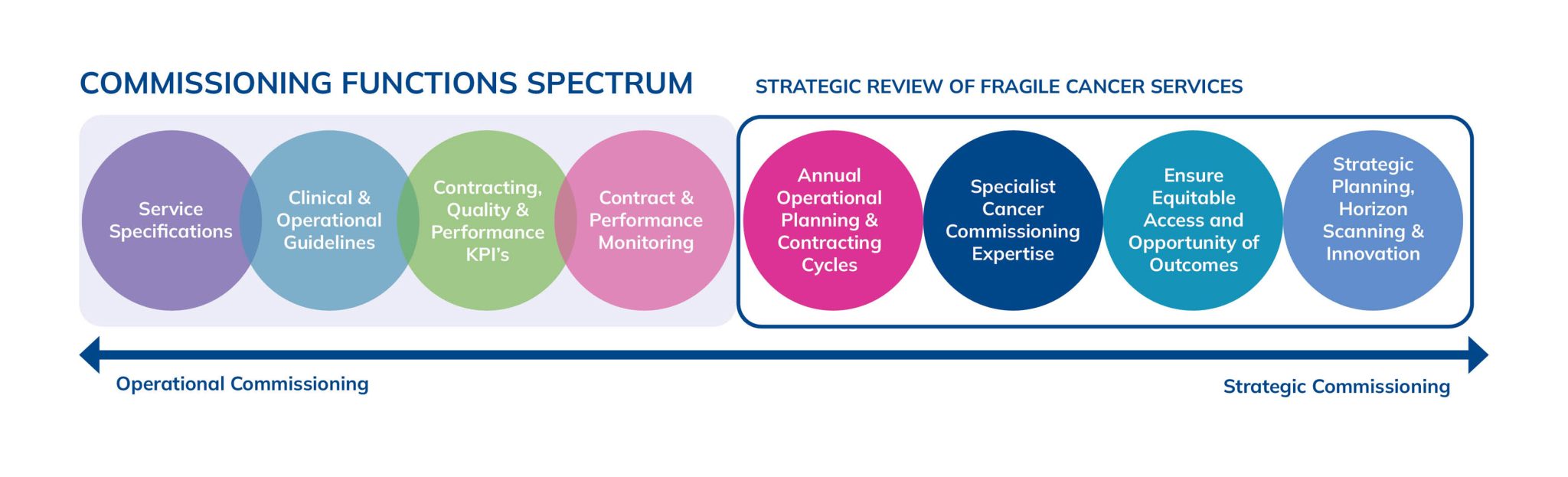
Commissioning includes a range of functions, from the operational nuts and bolts to strategic planning for healthcare needs, horizon scanning and embedding clinical and operational innovations into healthcare services.
Key benefits of commissioning
Driving quality and patient outcomes
- Setting clear service specifications ensures adherence to clinical guidelines and best practices, leading to better patient outcomes.
Fostering innovation
- Promoting cutting-edge technologies and innovative care pathways keeps cancer services at the forefront of advancements.
Safeguarding sustainability
- Ensuring services are fit for purpose and there is alignment between demand and capacity, together with adequate resources such as workforce and funding, supports continued sustainability.
Addressing disparities
- Reducing health inequalities by prioritising underserved populations and addressing barriers to access.
Our roadmap for cancer commissioning
The North Central London Cancer Commissioning Guide provides a comprehensive roadmap for the commissioning of cancer services in our area.
The guide outlines how cancer services in North Central London will remain patient-centred, high-performing and resilient in the face of evolving healthcare demands.
Recognising the need to future-proof cancer services, the guide integrates a framework for reviewing fragile services, providing a structured approach to identifying areas of service vulnerability, assessing risks and implementing targeted interventions.
Cancer commissioning cycle
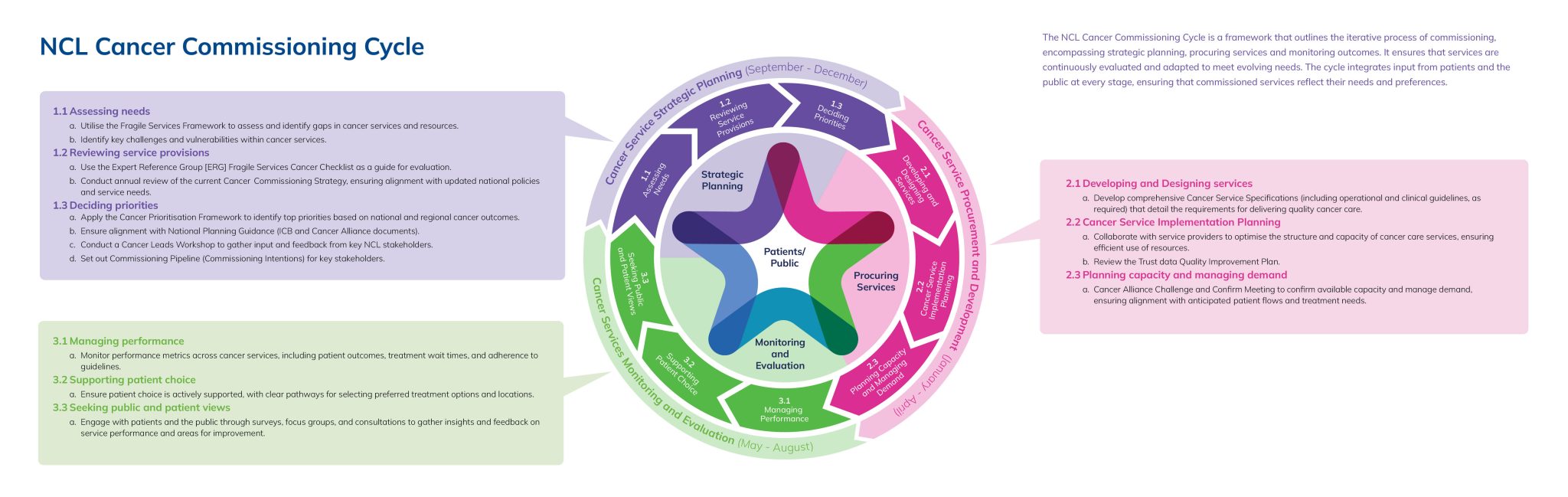
The NCL Cancer Commissioning Cycle is a framework that outlines the iterative process of commissioning, encompassing strategic planning, procuring services and monitoring outcomes.
It ensures services are continuously evaluated and adapted to meet evolving needs. The cycle integrates input from patients and the public at every stage, ensuring commissioned services reflect their needs and preferences.
Commissioning tools, templates and resources
Data directory
– A central repository of essential cancer datasets for informed commissioning decisions.
Project initiation document (PID) template
– A structured template to define project objectives, scope and implementation plans
Equality impact assessment – initial screening
Equality impact assessment
– Evaluates how a policy, project or decision may affect different groups. The goal is to identify and mitigate any potential negative impacts or inequalities, and to enhance positive impacts.
Data protection impact assessment
– Identifies and minimises data protection risks in projects that involve processing personal data.
Quality impact assessment tool and process
– Assesses the potential impact of a proposal on the quality and safety of care, including patient outcomes and experience.
Stakeholder analysis
– Identifies and assesses individuals or groups affected by or influential to a project, to inform engagement strategies.
Briefing paper template
– For summarising key information for stakeholders.
Communications plan on a page
– A concise summary template outlining communication objectives, audiences, messages, channels, and timelines.