
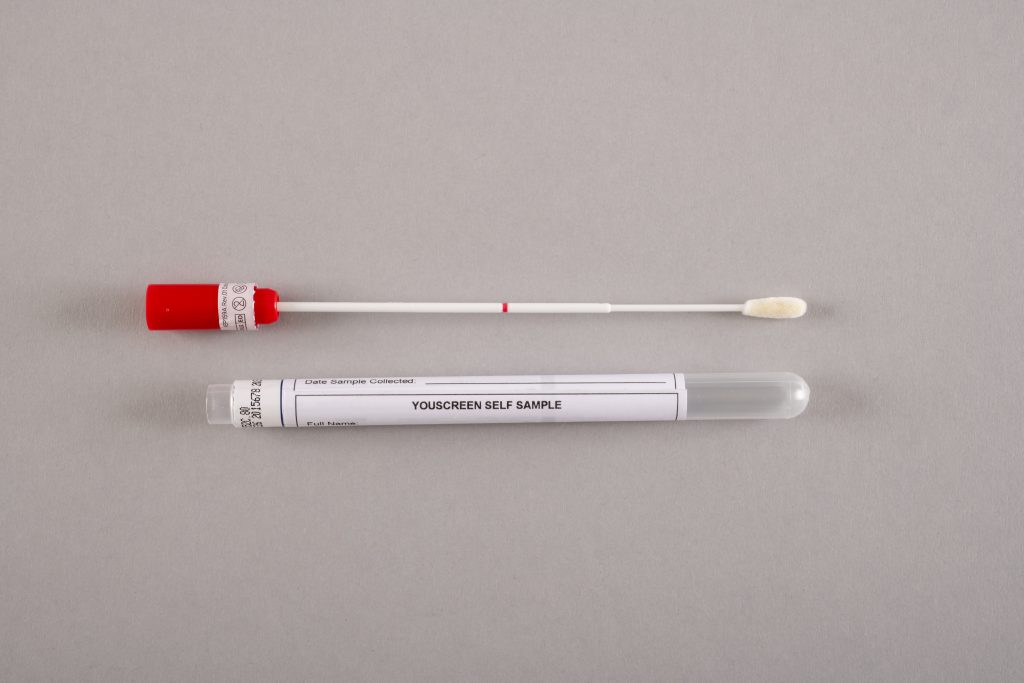
Do-it-yourself human papillomavirus (HPV) tests could enable more than a million more women in England to participate in cervical screening over the next three years.
The results of a research study carried out in north and east London offering a self-sampling kit to patients who are overdue their cervical screening are published today in eClinicalMedicine, a Lancet journal. The YouScreen study was conducted by King’s College London, sponsored by UCL (University College London) and funded and supported by the NHS North Central London and North East London Cancer Alliances.
The study provided self-sampling kits to test for HPV to women and people with a cervix who were at least six months overdue for their cervical screening.
133 local GP practices participated in offering the kits either opportunistically to their patients during a medical appointment or enabling the kit to be mailed directly to overdue patients.

Lead author Dr Anita Lim, from King’s College London, said: “Self-sampling has been hailed as a game-changer for cervical screening and we now have evidence in a UK population to show that it really is. Women who don’t come for regular screening are at the highest risk of developing cervical cancer. Cervical screening attendance has been falling in England for over two decades; currently a third of eligible women aren’t getting screening and in some parts of London this is as high as 50%.
“It is crucial that we make cervical screening easier for women by introducing innovations like self-sampling, alongside the current cervical screening programme, to ensure that they are protected from what is a highly preventable cancer.”
Self-sampling has already been introduced in several countries with the aim of increasing cervical screening participation rates including The Netherlands, Australia, Denmark and Sweden.
Emerging evidence from other studies suggests that self-sampling tests are similarly good at detecting pre-cancer cells as the standard cervical screening test taken by a doctor or nurse. People in the trial used a vaginal swab, like a long cotton bud, to take their sample either at-home or at the GP practice. Samples taken at home could be posted for free directly to the laboratory for testing. If HPV was detected, a follow-up test was required.
Clare Stephens, GP and Co-clinical director at North Central London Cancer Alliance, said: “In primary care we have been working for a long time to improve the uptake for cervical screening. The results from YouScreen show that we can make a significant difference to the uptake of screening by offering an alternative self-sampling test instead of a screening appointment within the GP practice. We are glad to have supported the project with funding, stewardship and the engagement of local GPs.”
Cervical cancer is highly preventable by screening for the human papillomavirus (HPV) which can lead to cervical cancer. Those not attending screening, or infrequently attending screening, are at the highest risk of developing cervical cancer.
The YouScreen trial offered HPV self-sampling kits to over 27,000 un- and under-screened women aged 25-64 from 133 GP practices in north and east London between Jan 2021 and Nov 2021. 8,838 people sent back self-samples; 64% were from ethnic minority groups and 60% from deprived populations. 12% returned self-sample kits when mailed directly to them from the screening programme and 55% returned a kit when it was offered at their GP practice.
This improvement in numbers is well above those achieved by previous nation-wide campaigns to increase uptake which have resulted in a 0.6% increase.
The standard cervical screening test is an intimate procedure. A variety of barriers can stop people from attending, even though it can be a life-saving test. People may be embarrassed or worried about pain, they might have a history of abuse or trauma or have other physical or personal reasons for not coming and sometimes it’s simply having a busy lifestyle and not getting around to it.
Feedback from GP practices and trial participants was overwhelmingly positive, including reports of self-sampling enabling screening in those who have not historically engaged.
Professor Peter Sasieni, head of the research group at King’s College London and now at Queen Mary University of London, said: “We are well on our way to turning cervical cancer into a rare disease in the UK. This is thanks to a world-class cervical screening programme, the HPV vaccine and the ability to now test for HPV.
“Unfortunately, women born before 1990 are unlikely to benefit from the HPV vaccine so regular screening is vitally important to protect those who have not been vaccinated from this cancer.
“YouScreen showed that this simple test is popular with both women and GP practices and could boost screening participation in England by over a million over three years. That in turn would help to accelerate the decline in cervical cancer rates.”
Mairead Lyons, a Senior Consultant to YouScreen from King’s College London, said: “Self-sampling is a win-win for everyone. YouScreen demonstrated that for GPs, nurses and other healthcare professionals at general practice, being able to offer self-sampling to under-screened women when they attend for other appointments is a pragmatic way to deliver cervical screening to those at risk.”
NHS England’s director of screening and vaccination, Deborah Tomalin, said: “It’s extremely promising that this study suggests simple DIY swab tests could have a really positive impact in supporting more women to take part in cervical screening from their own homes, and the NHS will now be working with the UK National Screening Committee to consider the feasibility of rolling this out more widely across England.
“In the meantime, if you are invited for cervical screening by the NHS, it’s vital that you come forward – it could save your life and remains vital towards our ambition of eradicating cervical cancer in England within the next two decades.”